
How Relativism Got Meta
Speculations about a pernicious classification

What do you think of when you think of a moral relativist? Maybe a guy whose dating app photos are all of him holding up iguanas (with swipers usually thinking “Can I just take the iguana?”), and his favourite food is ayahuasca and his dream vacation is Sentinel Island. Maybe some lecherous x-ty-something philosopher of language who makes his research assistants sign NDA’s (an unfair stereotype — the relativists mostly tend to be well-behaved 😉). Or the old classic: a young sophisticate in a beret, smoking cloves. I don’t even know where you buy cloves. And I don’t want to know. Because I’m not a relativist. Also, smoking kills — luckily, mostly relativists.


I’m not pulling these characters out of mid-air. I connaître them. But now when I think of a relativist, I picture a seminar room full of earnest, anguished young-David-Foster-Wallace types wrangling over population ethics or possibilism vs. actualism, and then like a Ralph-Wiggum-type kid, as earnest as all the rest, but just much, much dumber, telling everyone that morality is whatever his grandmother in Decatur, Illinois thinks it is, ‘cause his grandmother bought him a tadpole for his birthday.1 Because his view is basically what moral relativism is. Only somehow relativism is worse, because there’s not even a tadpole.
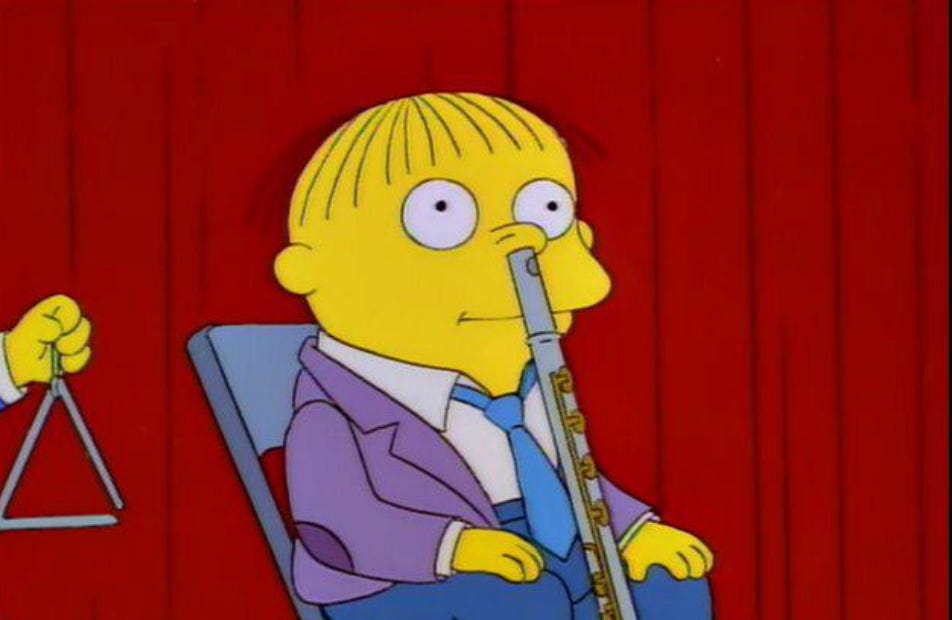
Okay, what I was trying to express with all of that is basically that relativism is not some view from “outside” of ethics, from a standpoint of bioanthropogenecenic or cynical or Continental or any other kinds of detachment, that would allow the moral relativist to look down at the petty squabbling of in-the-arena normative ethicists and snarf. In other words, it is not a meta-ethical view. What it is is a normative ethical view — of a piece with utilitarianism and contractualism and Ross’s theory of prima facie duties. Only it eats paste.
I’ll explain why I think all of this in just a moment. But one thing to say is that it won’t be original. I first remember reading about this insight in Ronald Dworkin’s paper “Objectivity and Truth: You’d Better Believe It”, which dropped back when people thought the Prodigy would be the new Nirvana. But I think it is widely accepted. In the same way I know that someone is a real basketball head if they think Jrue Holiday should be a perennial all-star, I know that someone is a real philosophy head if they think of relativism as a normative ethical view. So yeah, this is just kinda rehashing stuff that’s already in the literature.
The new thing I want to do in this post is speculate about why people don’t, like, immediately see this — why they think of moral relativism as this cool, detached, edgy meta-ethical view instead of the bad normative-ethical view it really is. It’ll be speculative, no empirical support whatsoever other than that furnished by the verstehen capabilities of yours truly. But someone should do the experiments!
Relativism as a Normative Theory
Just as the utilitarian thinks right and wrong depend on how much well being there’ll be if you do an action, and the deontologist thinks it maybe depends on the agent’s intentions or whether you’re initiating a new threat, and some people think it depends on whether you’re making the distribution of something more equal/less equal, the moral relativist says it depends on what people think — either a single person or a society, maybe the speaker(’s) or the agent(’s) or the appraiser('s).
Whoever’s takes are alleged to determine right and wrong, though, my rejoinder will always be the same. In the immortal words of Conor McGregor, who da fook is that guy?
Who da fook?, indeed. At least Ralph Wiggum’s grandmother got him a tadpole. So maybe her opinions about morality are worth something. But speaker relativism literally says that right and wrong depend on what the speaker of a sentence like “Blippity blop is right/wrong” likes or doesn’t like, or what the people around him think. Mutatis mutandis for appraiser relativism and the appraisal or evaluation of the truth of that sentence. But talk is cheap. Like, imagine some weirdo who got his nephew a poster of Randy Quaid in a hot tub with a cigar, framed by the words "Abandon All Hope Ye Who Enter Here” in Party LET font. That’s not a good present, I don’t think. So why should that person’s likes determine what’s right and wrong?
And not only is that person a scrub, but he’s also very distant from anything that matters morally. Suppose Caligula’s guards killed the young emperor. I’m not gonna look it up, but I’ve heard that they might have. Did they do the right thing? That would seem to depend on the guards and Caligula, and whether there was some other option, and what sick shit Caligula would’ve done had he not been killed. Who knows, maybe the guy who gets his nephew that Randy Quaid poster says “Between you and me, Caligula got a raw deal”. Well, speaker relativism says he’s right if he’s sincere. But the rightness and wrongness of killing is ultimately — and I emphasize ultimately, like there is no further explanatory layer — about some aspect of the killing, not about the opinions of some dipshit 2000 years hence.
Now at this point, I’m sure some people will think, “Oh, this guy’s talking about moral relativism in a really silly way, and he’s just doing ethics, and ethics is softcore. But there are all of these defenders of relativism and other stance-dependent views, and they’re giving Sam-the-Eagle-level seriousness and they’re doing philosophy of language and metaphysics and that’s hardcore. So I feel like this guy may not be trustworthy…” Well look, you can check my res gestae — this ain’t my first rodeo. I know there’s stuff you can do with idealization and the actuality operator, and so on and so forth, but none of that bears on the central problems with relativism, so I’m not going to go chasing after this or that variant like an obsequious little schoolboy. I would ask you to try to put yourself into my state of mind. Like, just be a normal guy and don’t think you need to bow before detachment and rigour and as John McDowell would put it, “anxieties” about morality and just ask yourself — isn’t it really weird that the moral quality of Frenchie assaulting Lily Belle depends fundamentally not on Frenchie and Lily, but on what some dipshit in another time and place thinks?


Now let me say, quickly, that it’s not like I think there are no plausible arguments for relativism or other stance-dependent views. [Warning: totally unexplained inside baseball ahead.] There’s something to Sharon Street’s argument that stance-dependent views explain the tendency of moral attitudes to be “on track” in a way that stance-independent views don’t. But stance-independent views can offer a kind of explanation of this as well, and as Richard Chappell has argued, it’s not obvious why the kind they can offer is supposed to be any worse. Also, as my former Ph.D student Jared Riggs pointed out, Street captures the intuition that our moral beliefs are largely on track — that’s a key premise in her argument — but does so in a way that is very much at odds with intuition; the idea is basically that our attitudes determine what’s right or wrong, and so whichever attitudes nature or nurture or whatever-the-heck would’ve endowed us with, these would’ve been accurate!
So that’s relativism, and why relativism is bad. So far, it’s just a normative ethical theory, about what morality ultimately depends on. Now, of course you can add more bells and whistles so that there are meta-ethical commitments. You can say “Oh, it’s not just that right and wrong depend on our attitudes. It’s that they are reducible — reducible, you see! Look, it’s metaphysics! — to our attitudes.” But you can do the same with other ordinary ethical theories. You can say “Oh, not only do I think it’s right to maximize well-being; I think rightness reduces! to facts about well-being.” Or you could add a thesis about meaning — about the reference or sense of “right” in terms of concepts like “appraiser” and “approval” and all that stuff. But you could add a thesis about the reference of “right” or its sense to most any other normative theory as well — “right” refers to the property of maximizing overall well-being, whatever. So yes, there could be metaethicized versions of relativism, just as there could be metaethicized versions of utilitarianism, say.
“But utilitarianism is a theory about what makes right acts right. Relativism, or stance-dependence generally, is a theory about what explains what makes right acts right — and so it’s meta-ethical,” someone might argue. I agree that there’s a (small) difference here, but it doesn’t really seem to be stepping outside of ethics so much as it is adding another layer to ethical explanation. I mean, I could have a theory that says “Oh, acting in accordance with such and such deontological rules is what makes for rightness, but what explains why it makes for rightness is that these are the rules that if generally followed would maximize aggregate well-being.” Just having an extra layer of explanation does not a meta-ethics make.
“But there is a difference concerning truth, you see?” an opponent might now argue. “The view you like requires stance-independent moral truth, objective truth, capital-T truth, while relativism and its cousins require only stance-dependent moral truth. And therein lies their advantage.” I think that’s a funny way to put things. It’s far more natural to say that both views commit you to moral truth — however problematic or unproblematic that is — and they merely disagree on whether moral truth depends on stances or not. If there’s a problem for plain old utilitarianism on account of its insistence on truth about morality, there’s a problem for relativism on account of the same. At the very least, if the relativist wants to say that her view carries a commitment to this other kind of truth — relative truth or something — this is not part of relativism as such; it’s an optional add-on.
But now the relativist might say that it’s an add-on that makes the view more plausible, because relative truth or stance-dependent truth is less ontologically, like, embarrassing or something than objective or stance-independent truth is. But I mean — why? Granted, on the face of it, some kind of naturalist, reductivist relativism is more ontologically parsimonious than any non-naturalist view, but that’s not a point in relativism’s favour, because both relativism and objectivism can be naturalist and both can be non-naturalist. But WTF is stance-dependent truth? Like, truth that cares a lot about what everyone thinks? And that makes it fit better into a respectable scientific worldview? People-pleasing is respectable? Not where I come from…
Okay, you get the picture; this is old hat to most people working in my field. And yet many people still think of moral relativism as a meta-ethical view that prescinds from ethics and judges it from the outside or something, not a normative ethical view that’s all like “I don’t have a red crayon; I ate it.” So, why?
How Relativism Got Meta: Three Hypotheses
Hypothesis #1: “Who Says?” and Sources
As I acknowledged above, a theory like relativism may seem to be adding another layer "underneath” an ordinary ethical theory. It says “Here’s what makes things right or wrong, and the reason this is what makes things right or wrong is blah blah something to do with the speaker’s approval/disapproval or something.” But: (a) non-stance-dependent theories could also have two layers, as explained earlier, and (b) why does having multiple explanatory layers like this make the theory “meta”?
But maybe it’s not just the extra layer; maybe it’s the content of that layer — the fact that it makes morality ultimately dependent upon people’s evaluative stances. Because one common expression of skepticism about morality or some putative moral rule is “Who says?” Someone has to “say”, is the assumption. This accords with claims to the effect that morality is “the moral law” and as such requires a law-giver, or that morality is normative and normativity has to have a source — where that’s something like law-giving or the will or taking a stand. Well, relativism does make morality dependent on something kindasorta like that. It seems to be doing more, then, than some non-stance-dependent theory is doing — not just saying what’s right and wrong and why, but also explaining law-y-ness or normativity. And so we may feel compelled to regard it as meta-ethical. Another way of looking at it: Suppose I were to ask what makes for a “good law”. One thing you’d want to explain is the “good” part — that threat and force pursuant to such a law would be justified by the harm, etc. that they would prevent; but that would not be enough — you’d also have to explain the “law” part, which you couldn’t do just by citing costs and benefits that would accrue were the law promulgated and enforced. You’d have to say that the legislature enacted it, or that it was the result of a referendum or an executive order, or something like that.
Now, I find it very implausible that morality should be thought of along the lines of positive law that needs a “source” or “law-giver” or anything like that. This is first and foremost for reasons of first-order ethics. I don’t think that the wrongness of cutting a stranger’s head off with a sword depends upon whether a literal morality-pixie sprinkles the action with literal pixie-dust — that just seems utterly beside the point — and similarly, I don’t think that the wrongness of such a thing depends upon any person or culture’s stance or command or gavel-pounding or JohnHancocking or any of that. The argument for this would be very much along the lines of the argument I offered above.
Someone might argue that it’s part of the very concept “wrong” that it applies to actions only if there is some kind of proscription or disapproval or something like that, so I can’t declare such things irrelevant on pain of conceptual incoherence. But then I’d simply switch my attentions to a different concept — “shmong”, let’s say — that has the same role vis a vis motivation and affect that “wrong” has, but does not bear the same constitutive inferential connection to the concepts of proscription or disapproval or whatnot. Here, as elsewhere in moral theory, you cannot — and really, should feel ashamed if you try to, if I’m keeping it 💯 — get your desired conclusion about morality by baking it into the concept. But now you might say: "No, but the prescription or disapproval is part of what determines the extension of concepts like ‘wrong’; if you don’t have these, then there can’t be anything that ‘wrong’ applies to.” (Shades of Anscombe’s “Modern Moral Philosophy” here.) Well, this is a very thorny issue, but long story short — No, I don’t think that these are required to determine an extension for a normative concept. My 2022 book is basically about this. I believe in, to use Matti Eklund’s phrase, “referential normativity”. But yeah, another topic for another time. (But you can ask in the comments.)
Even if morality requires some kind of source in the form of something like a command, it’s not exactly clear how most versions of relativism provide it. I mean, relativism starts to look very implausible when it makes right and wrong depend on peoples’ actual attitudes; insofar as relativism even approaches extensional adequacy, it is relativism that makes right and wrong depend on the attitudes people would have if they were idealized — e.g. if they knew all of the relevant non-moral facts, full imaginative acquaintance with others’ pleasures and pains and longings and all that, etc. But if that’s what right and wrong depend on, it’s hard to see how there’s any lawgiver or source of normativity here. I mean, the fact that if Zohran Mamdani were better informed, fully rational, etc., he would oppose rent control doesn’t mean that this is the law. Now, maybe people who see morality this way could say that positive law and moral law work differently, so that your non-existent ideal self’s attitudes suffice for the latter even though non-existent ideal elected officials’ attitudes don’t suffice for the former. I mean, I don’t know, and at a certain point I don’t care.
And so it’s far from clear, for a couple of reasons, that this “law-giving” role is one that anything needs to play, and it’s far from clear that people’s stances can play this role. Additionally, this does not seem to be a role that has anything to do with ontological parsimony or explaining synthetic a priori knowledge or anything of that sort. I’m satisfied, then, to count the foregoing as a debunking explanation of why people might be inclined to count relativism as a meta-ethical thesis, rather than a non-debunking explanation of why it should count as such.
Hypothesis #2: Foreground and Background
My sense is that people do not tend to adopt relativism because they explicitly look out at the various things that morality might depend on and think “Oh yeah, what the yahoos on the street corner think — that’s clearly it — not so much pleasure and pain and liberty and great deeds and equality and so forth.” Rather, they adopt it in response to hard-to-notice discursive pressures. James Beebe and David Sackris did a study where they tracked acceptance of moral objectivism across the lifespan, and found that it was lowest in one’s late teens and early twenties. Now, some people may attribute this to postmodernist professors or whatever. But very few philosophy professors accept moral relativism, and I’d venture to say almost none (a) accept it unreflectively, and (b) would ever present it to students as the unquestioned only viable option. Our classrooms are places where relativism — and lots of views, but especially relativism — is challenged, not taken as obvious. As for the other humanities? Well, my sense is that, at least these days, they’ve got 99 problems but relativism ain’t one.
The better explanation of this “college relativism” phenomenon goes like this: Students are thrust into this social environment in which everyone has different views, and they don’t really have the skills to convince people of their views, to persuade them (I mean, I’m not sure I do either — it’s hard!), and also most of them want to be agreeable and chill and not the asshole in seminar. This combination of diversity of views, dialectical impotence, and motivation to fit in and have friends, etc., is central to the university experience. Now, there is certainly a lot of discussion of values on college campuses — in the classroom, in the dorms, in protests on the campus green, in presentations by visiting speakers. There’s discussion of Israel and Palestine, and immigration, and Trump, and AOC and Mamdani, and the grad student union, and disability accommodations, and trans issues, and so on. These are the “foreground” values — the ones that we view as up for discussion or advancement.
By contrast, the discursive values of not saying “I’m right and you’re wrong”, and not presenting yourself as a moral expert and your classmate as a moral doofus — well these are all background values. They’re what we take for granted in discussion that is focused on Israel and disability and libertarianism etc. Debate here is like a scientific instrument used to study the workings of the world while we take for granted facts about the workings of the instrument. Relativism seems like something close to a background, taken-for-granted norm of debates of this sort. You’re not supposed to act like an expert, pull rank, put yourself above others.
And so I claim that relativism might look meta-ethical because it’s a theory that’s seen as capturing norms that are so far in the background of debate and discourse that they scarcely show up as norms at all. Utilitarianism and deontology and egalitarianism and libertarianism — well, these are theories that seem to take sides on the “issues of the day”; relativism, while it takes an evaluative side as well, seems to take the unquestioned, taken-for-granted side regarding what we find ourselves doing as part of our focus on Israel and disability and so forth.
Hypothesis #3: Moral Codes vs. (wait, “vs.”?!?!) Real Morality
Nobody would ever confuse claims about amount of toilet paper left in the bathroom with claims about people’s beliefs about the same. Here we make the clear and obvious belief vs. reality distinction. But this is less common when it comes to morality. Some examples:
I’ve absolutely heard people with some kind of presence or forum say that we don’t need God for morality, because look, atheists can be moral, or societies built around non-theistic religions can have moral codes recognizably like ours, and so on.
Similarly, I’ve often had the experience of someone saying that morality can’t be objective, or stance-independent, simply because there are so many different moral codes, because there’s so much moral disagreement — as if it’s just obvious.
Now, these kinds of thoughts are built on confusions, it seems to me. Nobody doubts that societies can have moral codes without God’s commands; the question is whether anything can actually be moral in the absence of such commands. And obviously the inference from “there’s disagreement” to “there’s no right answer” is too quick. I mean, there’s a right answer about whether the God of the Bible exists, although I don’t expect disagreement about this matter to be settled anytime soon. The important thing is that thoughts like these reveal something about the way people so readily conflate questions about morality with questions about human moral codes. It even comes up, tacitly, in people’s framing of “the skeptical question” as “why be moral?” — as though there’s this thing, morality, that just obviously exists and we see it all around us in the form of “norms”, and then the question is just whether to follow them.
It’s not surprising that people think like this. It is hard to come upon what strike us as proofs or as evidence that our ethical views are mistaken — proofs or evidence that would rupture our Edenic certainty and give rise to a sense of the gap between appearance and reality. I’m not saying that no such proofs or evidence exist; it’s just that for various reasons they’re hard to come by. Thus many people find themselves in the inverse position of young children who fail the “false-belief” test. These children do not fully cognize the gap between representation and reality because they do not fully grok the former; by contrast, people who fail to distinguish between moral codes and morality fail to fully cognize the very notion of a moral reality distinct from our representations of it.
But if you do not cleanly distinguish between these concepts, relativism will be all but inevitable. It is controversial whether right and wrong differ between cultures. Those who accept stance-independent morality will say that they do not differ; it’s just that on any given moral question, some cultures will get things wrong. But it is uncontroversial whether moral codes differ between cultures. They obviously do.
Don’t be all huffy, relativists. You can make fun of quietists, too. I mean, picture some pasty English guy who’s always half-mumbling about the whirl and wail of our “form of life” and is calling everything “wicked” and…oh, I see. I see. You want to make fun of me. Yeah. Fair play. Well, you could talk about how my whole meta-ethical view is question-begging, or that it’s rather transparently driven by resentment against those who are working in areas of philosophy that are seen as more rigorous than mine are, or that it’s not that different from expressivism, but I wrote a whole book like it was suuuuuuuuper-different. Yeah, lots of material. But at least I’m not a relativist. ;-)
I think I’ve had a different path to relativism than the ones you mention. My relativism doesn’t need anyone to “say” what’s right and wrong, or a conception of “law”, or even rest on people’s “approval” of things. My relativism just falls out of boring old utilitarianism.
In your drawing of Frenchie and Lily Belle, you left out something important for the utilitarian. What’s wrong is not the bare fact that someone’s hands were in some place - it’s that some of the people involved *wanted* the hands *not* to be in that place. I think that what makes things right or wrong is whether or not they promote the interests of the people that are affected. But then there’s the problem of interpersonal utility comparisons. Even if everyone has their own utility scale, there doesn’t seem to be a fact of how units on one scale translate to units on the other scale. And *that’s* where the relativism comes in.
Every way of trading off utility increments on different people’s scales (where everyone’s scale gets positive weight) is a stance. Being right or wrong depends on whether the net result on the stance is positive or negative. There is nothing that makes one stance the objectively correct way to trade off the interests of the infinitely many beings in the universe that have interests.
I enjoyed the discussion about stance-dependence and independence but, while I’m sure you haven’t mistaken the definition of relativism, I just don’t think most “relativists” ascribe to that definition (they are averse to that sort of thing). I think people, most of them not glue-guzzlers, attempt when they are about five, when they first begin to think questions about other minds are trivial and hardly worth asking (false belief video), to define the world outside themselves by guessing, as it were, the crayons of good and bad in every box. Lots of things are simple. Behind the doors of one action, a world blood-red. Behind the garden gates, the verdant greens. Somewhere in the bottom drawer of a cubicle you have to search from 9 to 5, the musty green of paper money.
Lots of things in life have vibrant color, so we can see them clearly, not to say we always treat them rightly. These are the sorts of things moral theories start from. Perfect little tea parties.
People tend to grow out of that mode when they go through experiences so complex they just don’t know, standing there in the midst of it, neither by prediction or by hindsight, what to ascribe to that situation. Most of these situations are so resoundingly gray at every scale that the idea of moral color doesn’t even seem relevant. Crayons and candles are both wax. They make shit versions of each other, but one can imagine the other. Something you’ve said before describes the way people escape that moral paralysis is usually by innate reaction, acting say toward a drowning or injured person by rendering care immediately, rather than calculating the moral payout, probably taking on the character of their environment and personal experience more than any objective approach.
I think most relativists, though now I’m just speaking about people who might end a long vent with a friend with “well, you know, its all relative”, who as you say, have moral anxieties and “want to be agreeable and chill”, don’t really think about things in terms of stance-dependence but rather as an “I don’t know, who am I to say?” That stance is much closer to the distant meta theory they suggest. Although, you’re absolutely right that, wielded as a theory they want others to adopt, becomes normative, and when communicated, takes on this surface of stance-dependence as a way to coordinate its followers.
The different things in minds and cultures are not so different from crayons and candles. They make shit versions of each other, but one can imagine— it’s all wax. So people learn to let the one with the fairy wings wave the wand, and the one with the top hat go mad. And when they’re older they let those with structure pretend there’s some hidden objective order. And when they are older they see that, actually, yes, there is some value in that, and maybe morality isn’t much like money, where one can print out pleasure and punish all pain and by the log of all the frolic and flogging measure out just how right something is. That maybe life is a bit bigger than what we can understand, and that is exactly what makes it priceless.