
More on Relativism
Reflections of a honey badger in summer

Turns out that no amount of adrenochrome can foil time the avenger, and that I have become, despite my best efforts, a lion in winter. And so perhaps it is time for me to settle into a more resigned, world-weary mode of expression — one in which I lay down the need mix it up in the intellectual octagon here on Substack and elsewhere, and drift to something softer, less ambitious, more literary, more memoirish. Roger Scruton’s memoir was called Gentle Regrets; maybe I can change the title of my Substack to something along those lines — Mushy Longings: Modest Musings on the Passing Scene, or Slouching Toward Asheville: An Aging Hipster’s Indifferent Contemplation of Mortality and Desolation…
…SIKE! Not happening! Not today, not tomorrow, and Lord willing, not ever. The current plan is to be a hyperactive nerd who refuses to read the room and wants to be all “something’s wrong on the internet!” until the day I die. So fret not, dear reader.
Anyhow, in that spirit: I’ve been writing a bunch of stuff about how relativism and subjectivism are wrong. Lew Godwin has written a very thoughtful piece about how I’m wrong. So this post is about how he’s wrong. I’ll do some cutting-and-pasting, but it won’t be exhaustive. So READ HIS THING FIRST, okay?, and (ONLY!) then come back to this post.
Okay, read it? Don’t say you have if you haven’t. It’s just you and me buddy…
…okay, let’s get it on!
Moral Relativism as Normative Ethics
I keep saying that moral relativism is a thesis in normative ethics, and people on this app are, in the immortal words of Jim Norton, looking at me like I beat child sex abuse charges on a technicality.1

Godwin casts a similarly hairy eyeball in my direction. Just a couple of things I want to say:
First, I’m not the only philosopher who thinks about things this way. I’m not going to pull up a gazillion quotes, but I see my classification as akin to Simon Blackburn’s “internal” strategy or Ronald Dworkin’s “anti-archimedeanism”. So just to be clear — the situation is not “everyone thinks relativism is metaethics, but Andrew either doesn’t understand that, or else is trying to brute-force some reclassification”. It’s “some philosophers who work on this stuff think relativism is normative ethics, notwithstanding their appreciation that others classify it as metaethics; and some think it’s metaethics, notwithstanding their appreciation — I mean, I hope they appreciate it! — that others classify it as normative ethics”. Not sure if this matters re: the arguments, but it’s important that readers not get the wrong idea.
On to Godwin! He tells us that there is a “difference in kind between the questions” that relativism answers and those that a moral theory like utilitarianism answers. So let’s look at how he cashes out this purported difference:
Utilitarianism is a normative standard. It assigns rightness and wrongness. When, as utilitarians, we say, ‘Right depends on wellbeing,’ we mean, ‘You should treat an expected improvement in wellbeing as a reason for action.’
Relativism does not assign rightness or wrongness; it describes what moral properties like right and wrong are from the third-person perspective. The relativist’s answer is, roughly, that these are evaluative and action-guiding properties assigned by normative standards. When, as relativists, we say, ‘Right depends on someone’s stance,’ we mean to say that rightness does not exist independent of some normative standard that makes evaluations and recommends actions.
The relativist qua relativist cannot answer what right and wrong ‘depend on’ in the normative sense. This question invites the further question of what standard is under discussion. There is no metaphysically privileged standard; there are no sui generis moral truths, standing outside of the human world, that recommend this standard over another. If we are utilitarians, right and wrong depend on maximising wellbeing. If we are contractualists, they depend on following principles that would be accepted under ideal conditions. If we are common laypersons, they depend more on social norms.
I have two different reactions to different parts of this stuff about the “difference”. At some points, I just don’t see what the difference really amounts to. We’re told that acc. to relativism, “rightness does not exist independent of some normative standard…”. Well, according to utilitarianism, rightness does not exist independent of actions’ effects on well-being. We’re told that acc. to relativism there are no “sui generis moral truths, standing outside the human world”. Well first, I don’t know what sui generis means here; I’m pretty sure that as a quietist, I don’t believe in sui generis moral truths, and ditto for the expressivist or the naturalist realist. And yet all of us think morality is objective in the sense of being stance-independent. And more importantly, I think you could say something parallel about utilitarianism — that it says there are no moral truths, standing outside facts about well-being. I’m sure it’s frustrating for some people when I claim not to “get it”, but I’m sorry — I have yet to be shown that there’s anything to get here.
Moving on, my reaction to stuff like “relativism describes what properties like right and wrong are” is basically: “Yeah, I recognize the difference between saying that rightness depends on X and saying that the property of rightness is identical to the property of X — absolutely, 100%. But as I’m mapping out this corner of conceptual space, it’s a 2x2 matrix like this:
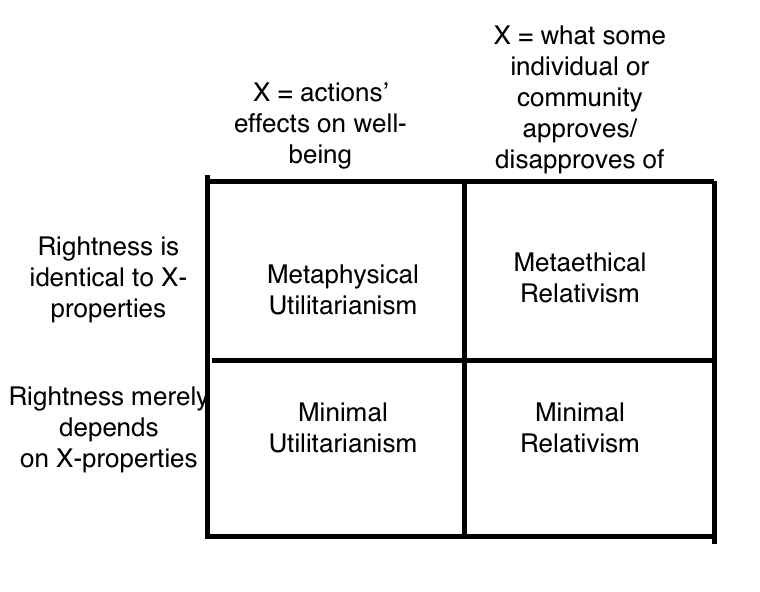
Now, maybe most people use “utilitarianism” to refer to what I call “minimal utilitarianism” in this table, and “relativism” to refer to what I call “metathical relativism”. But (a) if that’s true, it’s not obvious that it’s true — at least not to me, (b) that doesn’t mean the other boxes are unoccupied; they pretty obviously are, and (c) that seems more like a sociological fact than a deep, “carving conceptual space at the joints” kinda fact.
Semantic Utilitarianism
Just as I claim that we would “metaethicize” utilitarianism by accepting “metaphysical utilitarianism” (see above), I also think we could “metaethicize utilitarianism” by adding the semantic thesis that “right” refers to maximizing utility. Godwin says that we can’t do this “without leaving our brains at the door”. This seems to me to ignore the distinction between sense and reference. He writes:
Relativism puts forward that talk of ethical properties turns out to be talk of human attitudes and norms. I suppose that semantic utilitarianism would put forward that when we say that an action is ‘right,’ it turns out that we just mean that the action maximises the wellbeing of all impacted patients, considered impartially and in aggregate.
No one argues for this thesis because it is parallel-universe levels of crazy. One of the main objections to utilitarianism is that it is so often at odds with common moral judgements. The widespread inconsistency of utilitarianism with everyday moral talk suffices to disprove semantic utilitarianism.
In the world where SU holds true, it would trivially easy to prove that it is ‘right’ to pull the lever in the trolley problem. There is nonetheless widespread disagreement on problems where the utilitarian answer is obvious. Many persons argue that it is wrong to pull the lever. Sepielli and I would both agree (the psychopaths we are) that these persons are silly. However, we would not say that the deontologist suffers from some semantic confusion about what ‘right’ means, or that they misunderstand the question, or that their talk breaks from ordinary use, etc. Ethical talk that contradicts utilitarian principles is perfectly legible and in keeping with ordinary use.
I cannot see Sepielli’s angle on this point. It would be outlandish to put forward that rightness just refers to the property of maximising wellbeing; that is clearly not how competent speakers use the word.
Note that I put “semantic utilitarianism” in terms of reference, not sense. As far as I can see, nothing Godwin says here constitutes a plausible objection to the claim that “right” refers to utility maximization. Indeed, one of the main reasons people started to talk about the meaning of “right” etc. more in terms of reference than sense in the past 50 years (Boyd, Brink — just, like, so many people in the field) is that they wanted a theory of meaning for moral terms that sidesteps a lot of these worries.
For instance: As Putnam argued, “water” can refer to H20 even at a point in history where literally nobody thinks water is H20. People were wrong then, and as we learned more about science, we learned that H20 was the referent of “water” all along. Well, similarly, it might be that most people are wrong about ethics in the same way most people were wrong about water, and as they do more moral philosophy, they’ll hopefully arrive at the truth. And this isn’t just my idiosyncratic theory — although, would it matter if it was, assuming it was well-defended? Like, I don’t even care about reference and reference magnets and shit like that — I’m a simple little quietist. But this model of figuring out the reference of moral terms by doing moral philosophy is absolutely defended by some of the best people in the field — Mark van Roojen and Billy Dunaway and Tristram McPherson come to mind2 — and has deep motivations (e.g. preserving the autonomy of ethics), so whether it’s ultimately correct or not, I struggle to see how it’s ridiculous.
Now, Godwin or someone else might come along and say that, relativism is indeed a theory of the sense of moral expressions, and that it is plausible whereas utilitarianism construed as a theory of sense is absurd. I’m reluctant to write too much here bc I worry that nobody will give two shits, but let me just say my piece, and I am more than happy to elaborate if there’s genuine interest:
I don’t regard relativism as a plausible theory of the sense of “right” or any other ordinary moral expression — for some of the reasons that Godwin (rightly!) thinks utilitarianism is not a plausible theory of the same;
We do not have to simply take the concepts and terms bequeathed to us and deliberate in terms of those. This is one of the lessons of the very hot literature on “conceptual engineering” and “conceptual ethics”. And for my own part, I’m not interested in deliberating in terms of any moral concept or term that can be defined in such “thick” terms such that its sense is given by relativism or utilitarianism or any other such theory. My views about this shit are really complicated, but suffice it to say they’re closer to a view that says that the privileged normative concept can be defined entirely non-inferentially vis a vis motivation — nothing about anyone’s standards or utility or “moral fixed points” or any of that.
Ontology
Godwin purports to defend relativism (or at least defend it from criticism) on ontological grounds, but 90% of this section targets “Moral Platonism”. And, like, fair enough, there seems to be something weird about little moral thingamajigs floating around — again, I don’t know, I’m just a humble little quietist.
The important thing to say is that objectivism about morality, i.e. stance-independence basically, is just not committed to Platonism. There are expressivist objectivists, and quietist objectivists like me, and Kantian and Habermasian and other constitutivist objectivists (or at least, they’re anti-relativist), and as Godwin acknowledges, there are non-naturalist realist objectivists.
We hear nothing about any of these views, save the last, which Godwin simply asserts is “incoherent”. I’m kinda curious to hear why, but not super-duper curious. After all, I have enough trouble defending my own meta-ethical view; I’m not gonna do the naturalist realist’s homework for them. ;-)
So in conclusion…actually, fuck it; the kids want to play “Apples to Apples” now, so there’s no conclusion. Peace out!
“Of all the ways of describing the unpopularity of your views, Andrew, why that one? WTF is wrong with you?!” Okay, story time: So back when I was a teenager, I read an article about then up-and-coming comedian Jim Norton, which revealed that he opened his sets by quietly saying something like “Hi, how’s everybody doing?” to the audience, and then when this deliberately muted greeting failed to elicit a response, he’d say something like “Some audience you are; I try to be nice to you people, and you treat me like I beat child sex abuse charges on a technicality.” I thought this was fucking awesome, so it lodged itself in my long-term memory. Fast forward a decade, I’m attending a grad seminar at NYU, and decide to catch a show at the Comedy Cellar that night. Norton is on the bill, and lo and behold, he starts with his muted greeting, to which I reply “Woooooooooooo!” and applaud vigorously, to which he replied, “Wow, somebody’s excited”, moved on to his set, without making the “technicality” joke. If I live for a thousand years, men will still say, “This was his finest hour.”
The latter write: “If reference magnetism is a correct partial theory of how ‘ought’ gets its referent, then a community’s use of ‘ought’ refers to a property partly in virtue of its relative eliteness — a metaphysical property. If this is correct, then it might seem that normative theorizing should defer to metaphysical theorizing concerning which properties are elite. But…this does not seem right: we should determine what we ought to do by engaging in ethical theorizing, not by doing metaphysics.”